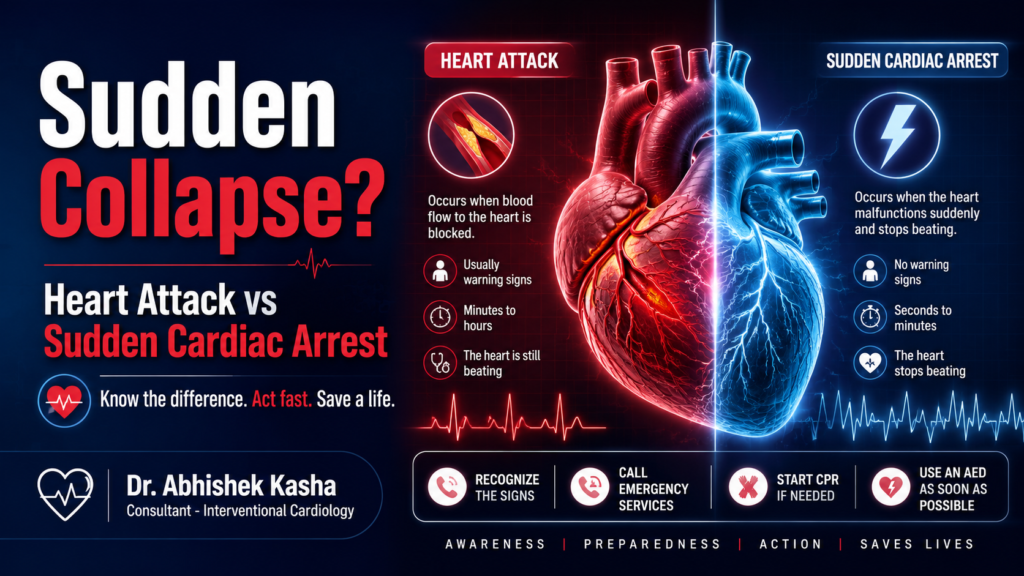
A Life-Saving Guide to Understanding Heart Attack vs Sudden Cardiac Arrest
Dr. Abhishek Kasha
Consultant – Interventional Cardiology
The First Few Minutes Can Decide Everything
Imagine this.
A person is sitting at home, talking normally. Suddenly, they hold their chest and say, “I feel heavy.” They are sweating. They look uncomfortable, but they are still awake.
Now imagine another situation.
Someone suddenly falls to the ground. They do not respond when you call their name. They are not breathing normally. Their body is still.
Both situations involve the heart.
Both are serious.
Both need urgent medical attention.
But they are not the same emergency.
One may be a heart attack.
The other may be sudden cardiac arrest.
Knowing the difference can help you take the right action at the right time.
The Simple Way to Remember
Heart Attack: The Heart Is Crying for Blood
A heart attack happens when blood flow to the heart muscle is blocked. The heart is still beating, but part of the heart muscle is not getting enough oxygen.
Think of it like a roadblock.
The blood vessel supplying the heart becomes blocked, and the heart muscle begins to suffer.
The person is often awake. They may complain of chest pain, heaviness, sweating, breathlessness, or discomfort spreading to the arm, jaw, shoulder, or back.
Sudden Cardiac Arrest: The Heart Suddenly Stops Pumping
Sudden cardiac arrest happens when the heart’s electrical rhythm suddenly goes wrong. The heart stops pumping blood effectively to the brain and body.
Think of it like a power failure.
The person may suddenly collapse, become unconscious, and stop breathing normally.
This is a life-threatening emergency where CPR must be started immediately.
The Biggest Difference: Is the Person Responding?
This is the most important thing for the public to understand.
If the person is awake and talking
It may be a heart attack.
They may have:
- Chest pain or pressure
- Sweating
- Breathlessness
- Nausea
- Pain moving to the arm, jaw, neck, shoulder, or back
- Dizziness
- Unusual tiredness
They need urgent hospital care.
If the person suddenly collapses and does not respond
Treat it as sudden cardiac arrest.
They may have:
- No response
- No normal breathing
- Gasping sounds
- No movement
- Sudden loss of consciousness
They need immediate CPR.
Heart Attack vs Sudden Cardiac Arrest: Quick Comparison
| Point | Heart Attack | Sudden Cardiac Arrest |
|---|---|---|
| Main problem | Blocked blood flow | Electrical rhythm failure |
| Person is usually | Awake and conscious | Unconscious and unresponsive |
| Breathing | Usually present | Not normal or absent |
| Heart activity | Heart is still beating | Heart stops pumping properly |
| Main symptom | Chest pain or discomfort | Sudden collapse |
| Immediate action | Call emergency help and rush to hospital | Start CPR immediately and use AED if available |
| Risk | Can damage heart muscle | Can become fatal within minutes |
Heart Attack Warning Signs You Should Never Ignore
A heart attack does not always look dramatic. Many people wait because they think it is gas, acidity, tiredness, or stress.
This delay can be dangerous.
Common symptoms include:
1. Chest Pressure or Heaviness
The person may feel tightness, squeezing, burning, or pressure in the chest. It may not always be sharp pain.
2. Pain Spreading to Other Areas
Pain may move to the left arm, both arms, jaw, neck, back, shoulder, or upper stomach.
3. Sweating Without Reason
Cold sweating along with chest discomfort is an important warning sign.
4. Breathlessness
Some people may feel breathless even without severe chest pain.
5. Nausea or Vomiting
Heart attacks can sometimes feel like stomach discomfort.
6. Unusual Tiredness
This is especially common in elderly people, women, and people with diabetes.
7. Dizziness or Faint Feeling
A sudden feeling of weakness, dizziness, or near-fainting should not be ignored.
Special Warning for Diabetic Patients
People with diabetes may not always feel typical chest pain during a heart attack.
They may only experience:
- Sweating
- Breathlessness
- Weakness
- Mild chest discomfort
- Sudden fatigue
- Dizziness
- Stomach discomfort
This is why regular heart checkups are very important for diabetic patients, especially if they also have high blood pressure, cholesterol, smoking history, or family history of heart disease.
Sudden Cardiac Arrest: The Emergency That Gives Very Little Time
Sudden cardiac arrest can happen without warning. In some cases, the person may have chest pain, palpitations, dizziness, or fainting before collapse. But many times, the collapse is sudden.
When the heart stops pumping properly, blood flow to the brain stops. Within seconds, the person becomes unconscious.
This is why waiting for an ambulance without starting CPR can reduce survival chances.
What To Do If Someone Has Chest Pain and Is Awake
Do not panic. Do not delay.
Step 1: Stop All Activity
Make the person sit or lie down comfortably.
Step 2: Call Emergency Help
Call local emergency services immediately. Do not wait to “see if it settles.”
Step 3: Do Not Allow Walking or Driving
The person should not drive themselves or walk around.
Step 4: Avoid Home Remedies
Do not waste time treating it as gas or acidity if symptoms are suspicious.
Step 5: Watch Closely
If the person becomes unconscious or stops breathing normally, start CPR immediately.
What To Do If Someone Suddenly Collapses
This is the most important life-saving section.
Step 1: Check Response
Tap the person firmly and shout:
“Are you okay?”
If there is no response, act immediately.
Step 2: Check Breathing
Look at the chest. Is the person breathing normally?
Gasping is not normal breathing.
Step 3: Call for Help
Ask someone to call emergency services and bring an AED if available.
Step 4: Start CPR
Place both hands in the center of the chest.
Push hard and fast.
Aim for around 100–120 chest compressions per minute.
Do not stop unless:
- The person starts breathing normally
- Medical help arrives
- An AED asks you to pause
- You are physically unable to continue
Step 5: Use an AED if Available
An AED is a device that can give an electric shock to restart a dangerous heart rhythm. It gives voice instructions and can guide the rescuer step by step.
What Not To Do During Sudden Collapse
Many people lose precious time because of common mistakes.
Avoid these actions:
- Do not sprinkle water and wait
- Do not slap or shake aggressively
- Do not put anything in the mouth
- Do not give food or drink
- Do not wait for the pulse if you are unsure
- Do not crowd around the person
- Do not delay CPR
In sudden cardiac arrest, every second matters.
Can a Heart Attack Turn Into Sudden Cardiac Arrest?
Yes.
A heart attack can trigger a dangerous electrical rhythm disturbance in the heart. This can lead to sudden cardiac arrest.
That means a person may first complain of chest pain and then suddenly collapse.
This is why early action during chest pain is very important.
Who Should Be Extra Careful?
People with the following risk factors should be more alert:
- Diabetes
- High blood pressure
- High cholesterol
- Smoking
- Obesity
- Family history of heart disease
- Previous heart attack
- Heart failure
- Irregular heartbeat
- Kidney disease
- Sedentary lifestyle
- Recurrent chest discomfort
- Breathlessness on walking
- Fainting episodes
- Palpitations
For high-risk patients, prevention is better than emergency treatment.
When Should You Consult a Cardiologist?
You should consult a cardiologist if you experience:
- Chest pain or heaviness
- Breathlessness while walking or climbing stairs
- Palpitations
- Fainting or near-fainting episodes
- Swelling in legs
- Uncontrolled blood pressure
- Diabetes with heart risk factors
- Family history of heart attack
- Previous angioplasty or heart disease
- Repeated fatigue with exertion
Early evaluation can help detect heart problems before they become emergencies.
Prevention Starts Before the Emergency
A major heart event often has risk factors that can be controlled.
Important preventive steps include:
- Regular heart checkups
- Blood pressure control
- Diabetes management
- Cholesterol testing
- ECG when advised
- Echocardiography when needed
- Stress testing for selected patients
- Coronary evaluation if symptoms suggest blockage
- Quitting smoking
- Healthy diet
- Regular walking or exercise as advised
- Weight management
- Proper sleep
- Taking prescribed medicines regularly
Prevention is not only about avoiding heart attack. It is also about protecting quality of life.
The Life-Saving Message
Do not confuse heart attack and sudden cardiac arrest.
A heart attack often gives warning signs.
Sudden cardiac arrest may happen suddenly.
If the person is awake with chest pain, sweating, or breathlessness, seek emergency care.
If the person suddenly collapses and is not breathing normally, start CPR immediately.
The first person at the scene can become the first life-saver.
About Dr. Abhishek Kasha
Dr. Abhishek Kasha
Consultant – Interventional Cardiology
Dr. Abhishek Kasha provides specialized care in general cardiology, interventional cardiology, heart failure, angioplasty, stenting, TAVR/TAVI, complex coronary interventions, diabetes management, blood pressure care, and preventive heart checkups.
Consultation Locations
AK Heart & Diabetes Center – Annapurna Polyclinic, Sullurpeta
Address:
Old Name – Dr. Masthanamma Hospital
Government Hospital Road,
Near Government Hospital,
Sullurpeta, Andhra Pradesh – 524121
Services: General & Interventional Cardiology, Diabetes Management, Heart Checkups
Timings: Monday to Saturday | 9 AM – 9 PM
Aster Narayanadri Hospital, Tirupati
Address:
Aster Narayanadri Hospital – Cardiology Department
National Highway 71, Renigunta Road,
SV Auto Nagar, Tirupati, Andhra Pradesh – 517506
Specialties: Heart Failure, Angioplasty, Stenting, TAVR/TAVI, Complex Coronary Interventions
Hours: Open 24 hours
Parva Medical Center, Tirupati
Address:
JCQ9+6GC Old Madhuri Hospital, KT Road,
Opposite Axis Bank, Bhavani Nagar,
Tirupati, Andhra Pradesh – 517501
Specialties: Cardiology, General Medicine, Diabetes & Blood Pressure Management, Preventive Health Checkups
Hours: Open 24 hours