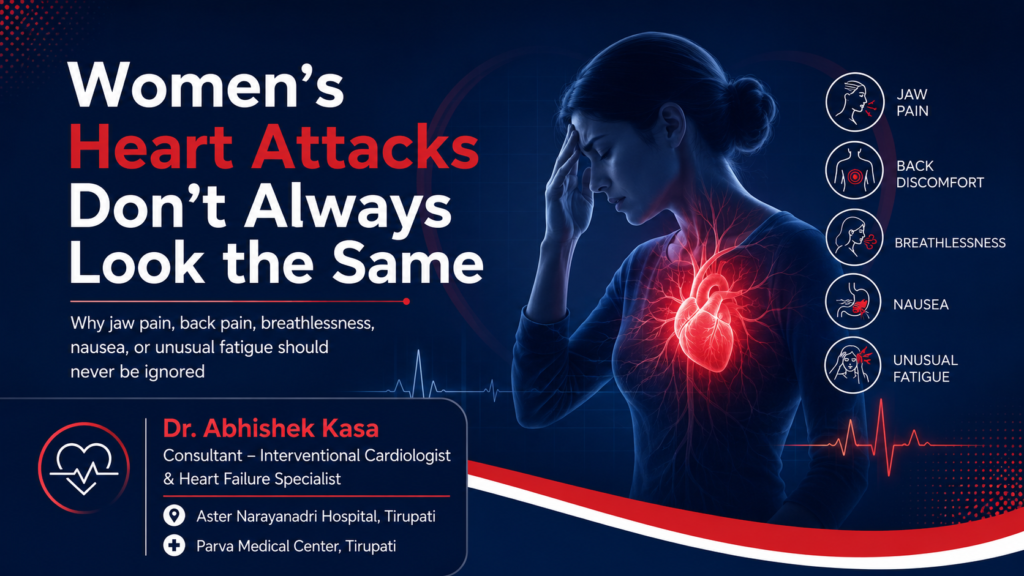
Why jaw pain, breathlessness, nausea or unusual fatigue should sometimes be taken as seriously as chest pain
When most people imagine a heart attack, they picture sudden, crushing chest pain.
That picture is not wrong—but it is incomplete.
Women can and often do experience chest pain during a heart attack, and it remains the most common symptom in women as well as men. However, women may also experience symptoms that are easier to dismiss: unusual fatigue, shortness of breath, nausea, dizziness, back discomfort, shoulder pain or jaw pain.
That difference matters because a heart attack does not become less dangerous simply because it does not look dramatic.
The myth: “A heart attack means severe chest pain”
Not necessarily.
Some heart attacks start suddenly, but others begin gradually with relatively mild symptoms. Discomfort may come and go, and in some people there may be very little chest pain at all.
This is particularly important for women because symptoms such as fatigue, nausea or breathlessness may initially be mistaken for stress, acidity, lack of sleep, menopause or simply “not feeling well.”
The danger is not the unusual symptom itself.
The danger is the delay it can create.
The longer heart muscle remains without adequate blood flow, the greater the potential damage.
What can a heart attack feel like in women?
1. Chest pressure or discomfort
Chest discomfort is still the most common symptom.
It may not always feel like severe pain. Some women describe:
- Pressure
- Tightness
- Squeezing
- Heaviness
- Fullness
- Burning or unusual discomfort
It can last several minutes or disappear and return.
2. Shortness of breath
A woman may suddenly feel unusually breathless while walking, climbing stairs—or even while resting.
Importantly, breathlessness can occur with or without chest discomfort.
If this is new, unexplained or accompanied by sweating, nausea, weakness or upper-body discomfort, it deserves urgent attention.
3. Jaw, neck, shoulder or back pain
Heart-related discomfort does not have to remain in the chest.
Pain may be felt in the:
- Jaw
- Neck
- Shoulder
- One or both arms
- Upper back
Women are more likely than men to report some of these accompanying symptoms.
A common mistake is assuming that jaw or back pain must automatically be dental or muscular.
Context matters.
4. Unusual or extreme fatigue
This is one of the symptoms that can be easiest to ignore.
A person may describe it as:
“I suddenly had no energy.”
or
“Even doing something simple felt exhausting.”
Unexplained tiredness can occur during a heart attack and is reported more often by women.
Fatigue alone usually has many possible causes, but sudden or unusual exhaustion—particularly with other symptoms—should not simply be dismissed.
5. Nausea, vomiting or “indigestion”
Heart-related symptoms can sometimes resemble a stomach problem.
Women may experience:
- Nausea
- Vomiting
- Upper abdominal discomfort
- A sensation resembling indigestion or acidity
The American Heart Association notes that women may experience upset stomach and nausea as part of a heart attack presentation.
This does not mean every episode of acidity is a cardiac emergency.
But unexplained indigestion accompanied by sweating, breathlessness, chest pressure, weakness, jaw pain or arm discomfort deserves much more attention.
“But I don’t have chest pain.”
That does not completely rule out a heart attack.
Heart attacks can occasionally happen with mild symptoms or even without recognizable symptoms. These are sometimes called silent heart attacks, and they are more common in older adults and people with diabetes.
This is one reason people with diabetes need to be particularly careful about unexplained breathlessness, weakness or other unusual symptoms.
Are heart attacks completely different in women and men?
No—and this distinction is important.
You may have seen social-media posts saying:
“Women don’t get chest pain during a heart attack.”
That is inaccurate.
Chest pain or chest discomfort remains the most common heart-attack symptom in women.
The difference is that women may be more likely to experience additional or less-recognized symptoms such as:
- Shortness of breath
- Nausea or vomiting
- Back, shoulder or arm discomfort
- Unusual tiredness
- Weakness
- Dizziness or light-headedness
So the message should not be:
“Women don’t get chest pain.”
It should be:
“Don’t wait for dramatic chest pain before considering the heart.”
Why are heart attacks sometimes missed in women?
Symptoms such as tiredness, nausea, indigestion, back discomfort or anxiety can overlap with many everyday conditions.
Women themselves may underestimate these warning signs.
There can also be differences in the causes and patterns of coronary disease. For example, the NHLBI notes that women are more likely than men to have some heart attacks not caused by typical obstructive coronary artery disease, which can complicate diagnosis.
Recent American Heart Association guidance also emphasizes that acute coronary syndromes in younger and premenopausal women can be under-recognized and may present with gastrointestinal, nonspecific or subtle complaints alongside more typical symptoms.
When should you seek emergency medical care?
Do not try to diagnose a possible heart attack yourself.
Seek urgent emergency medical attention if you develop new or severe:
- Chest pressure, tightness or pain
- Sudden unexplained breathlessness
- Chest discomfort spreading to the arm, jaw, neck or back
- Cold sweating
- Fainting or severe dizziness
- Nausea together with chest or upper-body discomfort
- Sudden unexplained weakness or extreme fatigue
This is particularly important when several symptoms appear together or when the symptoms feel distinctly different from anything you normally experience.
Do not wait for the symptoms to become unbearable.
Early treatment can limit heart-muscle damage and save lives.
Frequently Asked Questions
Can a woman have a heart attack without chest pain?
Yes. Although chest discomfort remains the most common symptom, some women can experience a heart attack predominantly through breathlessness, nausea, back or jaw discomfort, unusual fatigue or other symptoms.
Is jaw pain always a heart-attack symptom?
No. Jaw pain has many possible causes. However, sudden unexplained jaw discomfort—particularly when combined with chest pressure, breathlessness, sweating or nausea—should not be ignored.
Can acidity feel similar to a heart attack?
Yes. Heart-related discomfort can sometimes resemble indigestion or upper abdominal discomfort. Because symptoms can overlap, persistent or unusual symptoms should be medically evaluated rather than self-diagnosed.
Can extreme tiredness be a warning sign?
It can be. Unusual unexplained fatigue is among the symptoms reported during heart attacks and may be more common in women.
Are women with diabetes more likely to have subtle symptoms?
People with diabetes have a greater likelihood of silent or minimally symptomatic heart attacks, making unexplained symptoms especially important to investigate.
Should I wait to see if the symptoms disappear?
If you suspect a heart attack, no. Emergency evaluation is safer than waiting. Symptoms can fluctuate even during a genuine heart attack.
The takeaway
Heart attacks do not read a textbook before they happen.
They may begin with unmistakable chest pressure.
Or the first clue may be:
“Why am I suddenly so breathless?”
“Why does my jaw hurt?”
“Why am I unusually exhausted?”
“Why does this feel like terrible indigestion?”
Women should know both the classic and the less-recognized warning signs.
Because when it comes to a heart attack, recognizing an unusual symptom a little earlier can make an enormous difference.
Don’t wait for your heart attack to “look like” a heart attack.
Dr. Abhishek Kasa
Consultant – Interventional Cardiologist & Heart Failure Specialist
Aster Narayanadri Hospital, Tirupati
Parva Medical Center, Tirupati
This article is intended for general health awareness and does not replace individual medical evaluation. Suspected heart-attack symptoms require emergency medical attention.