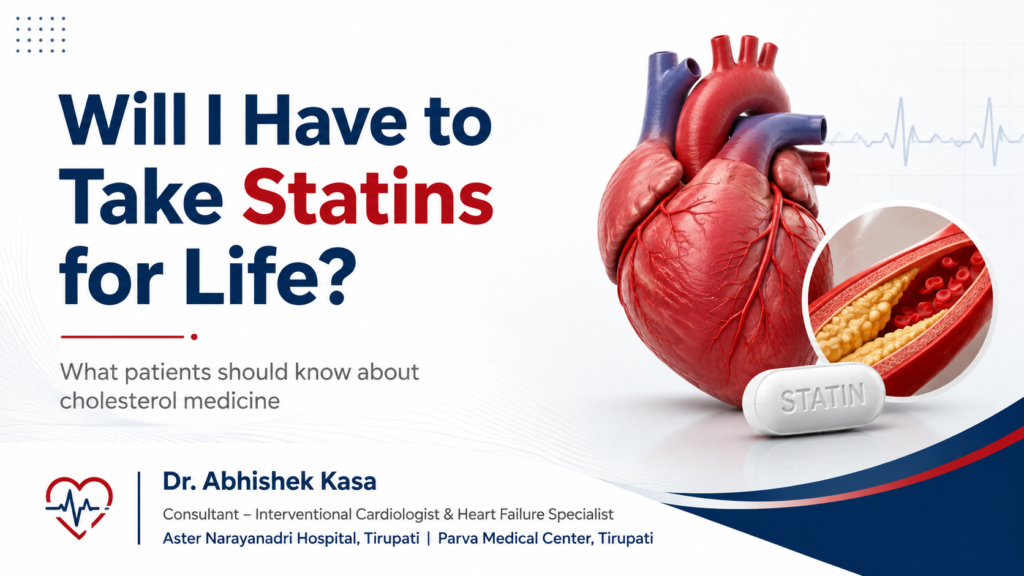
“Doctor, if I start a statin, will I have to take it forever?”
This is one of the most common questions patients ask after being prescribed cholesterol-lowering medication.
For many people, the fear is not actually about the tablet.
It is about the idea of becoming “dependent on medicine for life.”
Social media has made this anxiety worse. Some videos claim that cholesterol medicines weaken the body, damage muscles, cause diabetes or simply “hide the problem.” Others suggest replacing statins with supplements, detoxes or natural remedies.
The reality is more nuanced.
Not everyone who starts a statin must necessarily take it lifelong.
But equally important:
If you have a strong medical reason for taking a statin, stopping it simply because your cholesterol improved can remove the protection the medicine was providing.
The right question is therefore not:
“How quickly can I stop my statin?”
It is:
“Why was I prescribed it, and does my cardiovascular risk still justify taking it?”
What exactly does a statin do?
Statins reduce the production of cholesterol in the liver, especially LDL cholesterol, often called “bad cholesterol.”
But their benefit goes beyond simply improving a laboratory number.
High LDL contributes to the formation of cholesterol-rich plaque inside the arteries. Over time, these plaques can narrow the arteries or suddenly rupture, causing a blood clot.
That can lead to:
- Heart attack
- Stroke
- Angina
- Peripheral artery disease
- Need for angioplasty or bypass surgery
Statins help reduce LDL and lower the risk of future cardiovascular events.
This is why cardiologists often prescribe them based on a person’s overall risk, not merely because one cholesterol value is high.
If my cholesterol becomes normal, why can’t I stop?
This is where many patients understandably become confused.
Imagine a patient’s LDL cholesterol is high.
They start a statin.
Three months later, their LDL falls significantly.
They then think:
“My cholesterol is normal now. I don’t need the medicine anymore.”
But in many cases, the cholesterol is lower because the medicine is working.
Stopping the medicine may allow LDL levels to rise again.
It is similar to blood-pressure treatment. A normal blood-pressure reading while taking medication does not necessarily mean the underlying tendency toward hypertension has disappeared.
Who is more likely to need long-term statin treatment?
Statins are often recommended for longer periods when the risk of heart attack or stroke remains high.
This commonly includes people who have:
Previous heart attack
Once someone has had a heart attack, the goal is no longer just prevention of the first event. It is preventing the next one.
Coronary artery disease
If angiography shows significant plaque or coronary blockages, aggressive LDL reduction may be part of long-term treatment.
Previous angioplasty or stent
A stent treats a specific narrowing.
It does not remove the underlying tendency to develop atherosclerosis elsewhere in the arteries.
Statins remain an important part of secondary prevention for many such patients.
Previous bypass surgery
CABG creates new routes for blood flow, but the disease process that caused the blockages can continue.
Controlling LDL remains important.
Previous stroke or peripheral artery disease
Atherosclerosis can affect arteries throughout the body, not only the coronary arteries.
Diabetes with elevated cardiovascular risk
Diabetes significantly increases the lifetime risk of cardiovascular disease, so statins are frequently recommended depending on age and overall risk.
Very high LDL cholesterol
Some people have genetically determined high cholesterol.
Lifestyle improvements are still important, but they may not be enough to bring LDL into a safe range.
So when might a statin not be lifelong?
This depends entirely on why it was started.
For example, a person with moderately elevated cholesterol but otherwise low cardiovascular risk may improve:
- Diet
- Weight
- Exercise
- Blood pressure
- Diabetes control
- Smoking status
If their overall cardiovascular risk becomes sufficiently low, their doctor may reconsider the dose or need for medication.
But this decision should be based on a risk reassessment, not simply on the patient feeling well.
There is no universal rule saying:
“Once you start statins, you can never stop.”
And there is also no safe universal rule saying:
“Take statins for six months and then stop.”
Treatment has to be individualized.
“But I’ve heard statins damage everyone’s muscles.”
This is one of the most common fears online.
Some patients taking statins do experience muscle symptoms such as:
- Muscle aching
- Soreness
- Cramping
- Weakness
These symptoms deserve attention.
However, that is very different from saying that statins permanently damage everyone’s muscles.
Severe statin-related muscle injury is uncommon.
If muscle symptoms develop, your cardiologist may consider:
- Checking for other causes
- Measuring relevant blood tests when appropriate
- Reducing the dose
- Changing to another statin
- Using a different dosing strategy
- Adding or switching to another cholesterol-lowering medicine
The answer should usually be evaluation and adjustment, not silently stopping treatment.
Do statins cause diabetes?
This concern also contains a small element of truth that can become exaggerated online.
Statins may slightly increase blood glucose levels in some individuals, and there is a small increase in the risk of developing diabetes.
This effect appears to be concentrated particularly among people who already have risk factors such as:
- Prediabetes
- Obesity
- Metabolic syndrome
- Elevated fasting glucose
But the key issue is balance.
For people at significant risk of heart attack or stroke, the cardiovascular benefit of statins generally outweighs this relatively small diabetes risk.
It would therefore be misleading to say:
“Statins cause diabetes, so they are dangerous.”
Medicine is about comparing risk versus benefit, not looking at one possible side effect in isolation.
What does the evidence actually show?
Statins are among the most extensively studied cardiovascular medicines.
Large randomized clinical trials involving many thousands of patients have repeatedly shown reductions in major cardiovascular events among appropriately selected patients.
One of the landmark studies was the Scandinavian Simvastatin Survival Study, commonly known as the 4S trial.
It helped establish that lowering cholesterol with statin therapy in patients with coronary heart disease could reduce major cardiac events and improve survival.
Since then, decades of trials and large meta-analyses have reinforced the role of LDL lowering in cardiovascular prevention.
This is very different from many supplements promoted online.
A supplement may lower a laboratory marker slightly.
That does not automatically mean it has been shown to reduce:
- Heart attacks
- Stroke
- Cardiovascular death
Those outcomes require proper clinical trials.
What about “natural cholesterol supplements”?
Patients often ask:
“Can I replace my statin with something natural?”
That question needs careful handling.
Lifestyle measures are absolutely essential.
Everyone at cardiovascular risk should work on:
- Healthy eating
- Regular physical activity
- Maintaining a healthy weight
- Avoiding smoking and tobacco
- Controlling diabetes
- Controlling blood pressure
- Sleeping adequately
But lifestyle treatment and medication are not always interchangeable.
A patient who has already had a heart attack cannot assume that taking an unproven supplement offers the same cardiovascular protection as a therapy tested in large randomized trials.
The word “natural” does not automatically mean effective.
And the word “medicine” does not automatically mean harmful.
“If statins work, why do people still get heart attacks?”
Because cardiovascular disease is influenced by multiple factors.
These include:
- LDL cholesterol
- Diabetes
- Blood pressure
- Smoking
- Genetics
- Age
- Inflammation
- Kidney disease
- Obesity
- Physical inactivity
A statin lowers risk.
It does not reduce risk to zero.
A seatbelt does not prevent every road injury—but that does not mean seatbelts do not work.
In the same way, cardiovascular prevention is about reducing as many risk factors as possible.
What happens if I suddenly stop my statin?
If the medicine was prescribed because you are at high cardiovascular risk, stopping it may allow LDL cholesterol to rise again.
More importantly, you may lose some of the cardiovascular protection the treatment was providing.
This matters especially if you have:
- Already had a heart attack
- Undergone angioplasty
- Had bypass surgery
- Experienced a stroke
- Significant coronary artery disease
Do not discontinue cardiovascular medication simply because of a social-media video or because your latest cholesterol report looks normal.
Discuss it with your treating doctor first.
What if I genuinely have side effects?
You should not ignore them.
Tell your doctor exactly what you are experiencing.
For many patients, there are several options before completely abandoning cholesterol-lowering treatment.
Depending on the situation, your doctor may consider a different:
- Statin
- Dose
- Dosing schedule
- Combination therapy
- Non-statin cholesterol-lowering medicine
Modern lipid treatment is much broader than simply telling everyone to take the same tablet forever.
A better way to ask the question
Instead of asking:
“Will I have to take this medicine forever?”
Ask:
“What is my actual risk of a heart attack or stroke?”
“What LDL level should I aim for?”
“Why are you recommending this medicine for me?”
“Could my treatment change if my risk factors improve?”
“What should I do if I experience side effects?”
Those questions lead to a much more useful conversation.
Frequently Asked Questions
1. Once I start a statin, am I addicted to it?
No. Statins are not addictive.
The reason cholesterol may rise after stopping is not withdrawal. It is because the medicine is no longer lowering cholesterol.
2. Can diet replace statins?
For some lower-risk individuals, lifestyle improvement can substantially improve cholesterol levels.
For patients with established cardiovascular disease or very high risk, lifestyle treatment usually complements medication rather than replacing it.
3. Can I stop my statin after an angioplasty?
Do not stop it without consulting your cardiologist.
Angioplasty treats a particular blockage, while statins help address the underlying atherosclerotic disease process.
4. My LDL is now very low. Is that dangerous?
For patients at high cardiovascular risk, guidelines frequently recommend significantly lower LDL targets than those used for low-risk individuals.
Your target should therefore be based on your medical history and cardiovascular risk.
5. Can statins cause muscle pain?
They can cause muscle symptoms in some patients.
However, severe muscle injury is uncommon. Persistent symptoms should be evaluated rather than ignored.
6. Do statins cause diabetes?
They may slightly increase diabetes risk in susceptible individuals, but for patients who genuinely need statin therapy, the reduction in cardiovascular events usually outweighs that risk.
7. Are supplements safer than statins?
Not necessarily.
Supplements can also have side effects, contamination, interactions and variable quality.
More importantly, many have not demonstrated the same reduction in heart attacks and strokes that established therapies have shown.
8. Can statin doses be reduced later?
Sometimes.
The decision depends on your LDL level, cardiovascular history, treatment response and overall risk.
It should be discussed with your doctor.
The Takeaway
Being prescribed a statin does not mean you have entered into “lifelong slavery to cholesterol medicine.”
But neither should proven cardiovascular therapy be stopped because of fear created online.
For some people, statins may eventually be reduced or reconsidered.
For others—particularly people who have already had a heart attack, stroke, angioplasty, bypass surgery or established arterial disease—long-term cholesterol lowering can be an important part of preventing another event.
The goal is not to keep you on medicine forever.
The goal is to keep your cardiovascular risk as low as safely possible.
Question your medications.
Ask about side effects.
Improve your lifestyle.
Discuss alternatives when appropriate.
But make those decisions using your individual risk and reliable medical evidence—not fear, viral videos or supplement marketing.
Dr. Abhishek Kasa
Consultant – Interventional Cardiologist & Heart Failure Specialist
Aster Narayanadri Hospital, Tirupati
Parva Medical Center, Tirupati
This article is for general health education and is not a substitute for individual medical advice. Do not start, stop or change prescribed cholesterol medication without discussing it with your treating doctor.