By Dr. Abhishek, Interventional Cardiologist
Aster Narayanadri Hospital, Tirupati
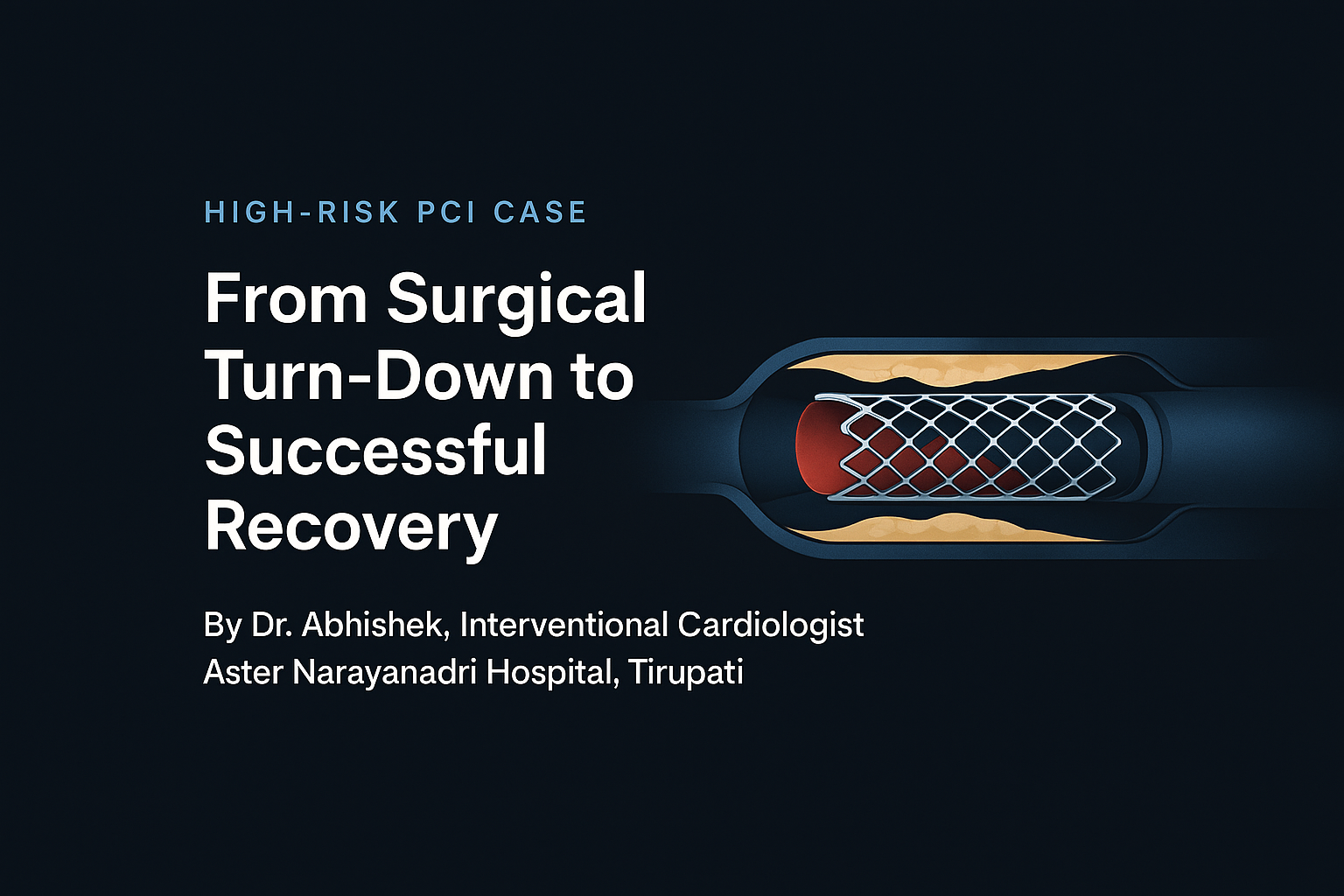
In contemporary cardiovascular practice, an increasing number of patients present with advanced coronary artery disease, multiple comorbidities, and poor ventricular function—factors that often render them unsuitable for conventional coronary artery bypass grafting (CABG). For such patients, the emergence of CHIP (Complex High-Risk Indicated PCI) offers a vital therapeutic pathway. This case highlights how a patient labelled “surgical turn-down” was successfully treated through a carefully planned, supported percutaneous coronary intervention.
The Patient: A High-Risk Clinical Profile
An elderly gentleman was admitted with recent acute coronary syndrome. His diagnostic evaluations revealed:
- Triple vessel coronary artery disease
- Severe left ventricular (LV) systolic dysfunction
- Diffuse and heavily calcified coronary anatomy
The combination of advanced age, compromised ventricular function, and complex anatomy significantly increased his surgical risk. Following detailed evaluation by the cardiac surgeon and multidisciplinary heart team, the patient was deemed unsuitable for CABG. The risk of perioperative morbidity and mortality outweighed the expected benefit of surgical revascularization.
However, being a surgical non-candidate does not eliminate the need for revascularization. His symptoms, ongoing ischemia, and deteriorating hemodynamics clearly indicated the need for an alternative strategy.
Heart Team Deliberation and Decision-Making
The heart team approach remains the cornerstone of complex coronary management. It ensures that the treatment plan aligns with clinical evidence, feasibility, and patient-centered goals. After a comprehensive discussion with the patient and his family, a consensus emerged:
IABP-assisted high-risk PCI offered a viable, less invasive, and safer alternative to CABG.
This decision was based on:
- The patient’s frailty and poor LV function
- Lower procedural stress compared to surgery
- Ability to support circulation during PCI
- Expected improvement in symptoms and quality of life
Following informed consent, a staged and structured plan was formulated.
Step 1: Clinical Stabilization Prior to Intervention
Before undertaking complex PCI in a patient with severely impaired ventricular function, optimization of hemodynamics is essential.
The patient was initiated on guideline-directed medical therapy (GDMT) for heart failure, including:
- Beta-blockers
- ACE inhibitors or ARNI
- Diuretics
- Antiplatelet therapy
- High-intensity statins
This pre-procedural optimization improved perfusion parameters, stabilized symptoms, and prepared the patient physiologically for the interventional procedure.
Step 2: Supported PCI – A Structured, Precision-Based Approach
Given the high-risk profile, mechanical circulatory support in the form of an Intra-Aortic Balloon Pump (IABP) was used to maintain coronary perfusion and hemodynamic stability throughout the procedure.
Access and Support Strategy
- A 40 cc IABP was introduced via the right femoral artery.
- The right radial artery served as the primary access for PCI, improving patient comfort and facilitating quicker mobilization.
Managing Heavily Calcified Coronaries
The LAD (Left Anterior Descending artery) and LCX (Left Circumflex artery) displayed severe calcific disease—a major predictor of procedural difficulty and stent failure if not properly addressed.
Therefore, lesion preparation involved:
- High-pressure non-compliant balloons
- Cutting or specialty balloons
- Sequential dilatation for optimal plaque modification
Appropriate lesion preparation was critical to ensuring stent expansion and long-term durability of the intervention.
Stent Deployment and Final Results
Drug-eluting stents were successfully deployed in both the LAD and LCX.
Angiographic evaluation confirmed:
- Excellent stent expansion
- Restoration of TIMI III flow
- No residual stenosis
- Good distal perfusion
The IABP was removed immediately following the procedure.
The large-bore access site was closed using the ProGlide vascular closure system, ensuring secure hemostasis and minimizing post-procedural complications.
Step 3: Recovery and Discharge
The post-procedural course was smooth and uneventful.
- The patient remained hemodynamically stable throughout observation.
- He was monitored for 24 hours in the CCU.
- Discharged within 48 hours in improved clinical condition.
Notably, he experienced significant improvement in:
- Breathing
- Functional capacity
- Overall quality of life
This rapid recovery reaffirms the effectiveness of supported PCI in carefully selected high-risk individuals.
Clinical Significance of the Case
This case exemplifies what modern interventional cardiology can achieve when clinical judgment, advanced technology, and coordinated teamwork converge. Patients traditionally deemed inoperable can now be offered meaningful, life-improving therapies.
Key observations include:
- Surgical turn-down should not end therapeutic consideration.
With evolving techniques, PCI backed by mechanical support offers a valuable alternative. - Proper lesion preparation is fundamental in calcified coronary disease.
Inadequate preparation leads to suboptimal stent expansion and long-term complications. - IABP-supported PCI significantly reduces procedural risk in patients with severe LV dysfunction.
- Heart team collaboration ensures the safest and most justified treatment pathway for complex cases.
- Timely intervention improves survival and quality of life, even in elderly patients with advanced disease.
CHIP: Redefining Possibilities in High-Risk Cardiology
CHIP interventions are increasingly becoming the standard of care for patients who previously had no viable options due to:
- Elderly age
- Multiple comorbidities
- Diffuse calcification
- Complex anatomy
- Low ejection fraction
- Prior surgical or interventional history
These procedures emphasize:
- Advanced plaque-modification tools
- Mechanical circulatory support such as IABP or Impella
- Precision-guided PCI strategies
- Lower procedural invasiveness
- Faster recovery timelines
This field continues to redefine what is possible for patients once dismissed as “too risky.”
Frequently Asked Questions (FAQs)
1. What does the term “surgical turn-down” mean?
It indicates that the cardiac surgeon considers the patient unsuitable for bypass surgery due to factors such as age, poor ventricular function, frailty, or complex coronary anatomy. It does not imply that treatment is no longer possible; rather, alternative strategies like high-risk PCI must be evaluated.
2. What is CHIP PCI and when is it used?
CHIP stands for Complex High-Risk Indicated PCI—a subset of interventional cardiology designed for patients with multiple blockages, calcification, weak heart function, or contraindications for surgery. It often involves mechanical support devices and specialized techniques.
3. Why was IABP used in this case?
The Intra-Aortic Balloon Pump augments coronary perfusion and stabilizes blood pressure during complex PCI. In patients with severe LV dysfunction, it provides vital circulatory support, reduces procedural complications, and enhances procedural safety.
4. Is PCI safer than bypass surgery for high-risk elderly patients?
In many cases, yes. PCI is less invasive, does not require general anesthesia, and offers faster recovery. However, the choice depends on coronary anatomy, patient stability, and multidisciplinary evaluation.
5. How are calcified lesions managed during PCI?
Specialty balloons, cutting balloons, and high-pressure dilatation techniques are used to modify calcified plaque. Proper lesion preparation is essential for optimal stent expansion and long-term outcomes.
6. How soon can patients return home after a high-risk PCI?
Many patients, including those in high-risk categories, can be safely discharged within 24–48 hours if clinical stability is maintained.
7. Does supported PCI improve quality of life?
Yes. Re-establishing coronary blood flow improves symptoms such as breathlessness, fatigue, and angina. Many patients regain functional independence and experience a significant improvement in daily living.
8. Are there risks associated with high-risk PCI?
While risks exist, including bleeding, vessel perforation, arrhythmias, and contrast-related kidney injury, they can be minimized through careful planning, use of mechanical support, and execution by experienced operators.
9. Can elderly patients benefit from such interventions?
Age alone should never disqualify a patient from receiving treatment. If symptoms are severe and the patient desires improved quality of life, PCI is often a suitable and effective option.
10. What does this case illustrate for the future of cardiology?
It demonstrates that with appropriate planning, technology, and expertise, complex coronary disease can be managed successfully even in high-risk and inoperable patients. This case reinforces the evolving role of CHIP PCI as a life-restoring option for those who were previously left untreated.