By Dr. Abhishek Kasha
Consultant Interventional Cardiologist & Clinical Lead – Structural and Complex Coronary Interventions, Heart Failure Program
Introduction
When it comes to treating complex heart blockages, precision, timing, and advanced interventional skill make the difference between decline and recovery. This is especially true in patients who carry multiple health challenges at once — heart failure, kidney disease, infection, and long-standing coronary artery disease.
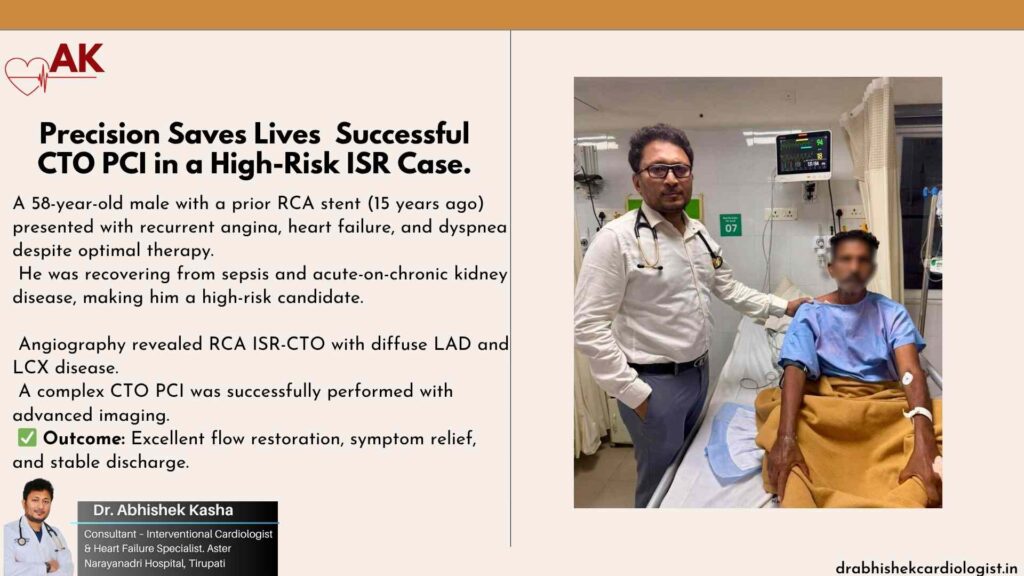
One such remarkable case was recently managed at Aster Narayanadri Hospital, Tirupati, where Dr. Abhishek Kasha, a leading expert in Complex PCI and Structural Heart Interventions, successfully performed a high-risk CTO PCI in a patient with in-stent restenosis (ISR) and chronic total occlusion (CTO) in the Right Coronary Artery (RCA).
This procedure not only reopened an artery that had been completely blocked but also restored the patient’s symptoms, heart function, and quality of life — all in a challenging clinical setting.
The Patient’s Story: A High-Risk Case with Multiple Complications
A 58-year-old male, known case of coronary artery disease, presented with:
- Recurrent chest pain
- Increasing breathlessness
- Worsening heart failure
- Fatigue on minimal activity
What made the situation more complex was his medical history and recent illness:
1. RCA Stent Placed 15 Years Ago
He had undergone a Right Coronary Artery (RCA) stent many years earlier. Over time, this stent had developed in-stent restenosis (ISR) — meaning the previously treated segment had narrowed once again due to scar tissue buildup.
2. Chronic Total Occlusion (CTO)
The ISR had progressed into a complete blockage — a 100% occlusion lasting for more than 3 months. This meant the artery was not supplying blood to a significant portion of the heart muscle.
3. Additional Illnesses Increased the Risk
The patient was simultaneously recovering from:
- Sepsis due to lower respiratory tract infection
- Acute-on-chronic kidney disease
- Poor functional reserve due to longstanding heart disease
These factors made him a very high-risk candidate, with multiple organs already under stress.
4. Coronary Angiogram Findings
The angiogram revealed:
- ISR with CTO in the RCA
- Diffuse disease involving the Left Anterior Descending (LAD) and Left Circumflex (LCX) arteries
Despite medications, his symptoms persisted, indicating significant myocardial ischemia.
Decision-Making: Why CTO PCI Was Required
Chronic total occlusion (CTO) intervention is one of the most advanced and technically demanding procedures in interventional cardiology. It is not performed routinely unless there is a clear benefit.
For this patient, the indications were strong:
1. Persistent Symptoms Despite Optimal Medical Therapy
Chest pain, breathlessness, and worsening heart failure persisted even after medications were maximized.
2. Viable Myocardium at Risk
The territory supplied by the RCA showed signs of:
- Ischemia (reduced blood flow)
- Stunned or hibernating myocardium
- Potential for recovery if blood flow is restored
3. In-Stent Restenosis (ISR) in a Previously Treated Artery
When ISR progresses to CTO, medical therapy alone is often insufficient.
4. Prevention of Future Heart Failure Events
Opening the artery can:
- Reduce angina
- Improve exercise tolerance
- Stabilize heart function
- Prevent hospitalization for acute heart failure
5. Modern CTO PCI = High Success + Low Complications
Thanks to:
- Microcatheters
- Specialized guidewires
- Dual coronary access
- Intravascular imaging (IVUS/OCT)
- Retrograde and Antegrade approaches
- CTO-specific algorithms
Highly complex cases can now be treated with excellent safety and success rates — even in challenging anatomy.
The Procedure: Precision CTO PCI Using Advanced Techniques
After stabilizing the patient from sepsis and optimizing kidney function, the team proceeded with a carefully planned intervention.
Step 1 — Dual Access Strategy
To fully visualize the blockage and understand the collateral circulation, arterial access was taken in two sites. This is standard for CTO PCI and helps guide the wires and catheters with accuracy.
Step 2 — Specialized CTO Wires and Microcatheters
The blocked segment was approached meticulously using:
- Dedicated CTO guidewires
- High-support microcatheters
- Sequential wire escalation techniques
This allowed controlled penetration of the hard, fibrotic occlusion.
Step 3 — Intravascular Imaging
Modern CTO PCI heavily relies on imaging such as:
- IVUS (Intravascular Ultrasound)
- OCT (Optical Coherence Tomography)
These help the operator understand:
- Exact vessel path
- Extent of restenosis
- Landing zones for stents
- Wire position confirmation
Imaging guidance dramatically improves precision and reduces complications.
Step 4 — Lesion Preparation
The ISR lesion underwent:
- High-pressure ballooning
- Cutting/scoring balloon use (if needed)
- Plaque modification
This prepares the vessel for optimal stent expansion.
Step 5 — Re-Stenting of the RCA CTO Segment
A drug-eluting stent (DES) was placed with careful attention to:
- Full lesion coverage
- Proper expansion
- No edge dissection
- Good distal runoff
Step 6 — Final IVUS Check
Ensuring:
- Perfect stent apposition
- Adequate lumen gain
- Smooth arterial flow
Outcome: Successful Flow Restoration & Rapid Recovery
The result was excellent:
- RCA blood flow was fully restored
- No complications
- Significant improvement in chest pain and breathing
- Better hemodynamics
- Smooth post-procedure recovery
The patient was discharged in stable condition, with clear improvement in symptoms and quality of life.
🧠 Understanding CTO PCI: When and Why It Matters
Many patients and families do not fully understand why CTO PCI is sometimes necessary. Here’s a quick explanation:
What is CTO?
Chronic Total Occlusion =
A 100% blocked coronary artery for more than 3 months.
When Do We Consider CTO PCI?
- Persistent angina
- Worsening heart failure
- Reduced exercise capacity
- Objective ischemia on testing
- Viable myocardium that can be saved
- ISR-CTO or long blockages
- When bypass surgery is high risk or not preferred
What Makes Modern CTO PCI Successful?
- Dual arterial access
- CTO wires and microcatheters
- Dissection-reentry techniques
- Retrograde approach when needed
- Advanced imaging (IVUS/OCT)
- Experienced operator + specialized cath lab
Success rates today are 85%–95% at high-volume centers.
🏥 Why This Case Is Special: Tier-2 City, World-Class Intervention
Traditionally, complex coronary interventions were possible only in metro hospitals. This case is proof that Aster Narayanadri Hospital, Tirupati, now delivers:
- Modern cath lab infrastructure
- Advanced imaging technology
- Skilled high-volume Complex PCI operators
- Comprehensive cardiac and heart failure care
- Multi-disciplinary support (nephrology, pulmonology, critical care)
Patients no longer need to travel long distances to cities like Bangalore, Hyderabad, or Chennai for complex procedures.
World-class cardiac care is now available closer to home.
Frequently Asked Questions (FAQs)
1. What is In-Stent Restenosis (ISR)?
ISR occurs when scar tissue grows inside a previously placed stent, causing the artery to narrow again.
In some cases, this narrowing progresses into complete blockage (ISR-CTO).
2. What is CTO PCI?
CTO PCI is a highly specialized procedure to open arteries that have been completely blocked for over 3 months. It uses dedicated guidewires, microcatheters, dual access, and imaging.
3. Is CTO PCI safe?
Yes. With modern tools and experienced operators, CTO PCI has high success rates and low complications.
Safety improves significantly when:
- IVUS/OCT imaging is used
- The operator has CTO training and experience
- The hospital has a dedicated cath lab setup
4. Why not choose bypass surgery instead?
CTO PCI is preferred when:
- The patient is high risk for surgery
- Only one artery is blocked
- There is ISR (blockage inside a previous stent)
- The patient prefers a minimally invasive option
Your cardiologist decides based on anatomy, symptoms, and overall risk.
5. How long is the recovery after CTO PCI?
Most patients:
- Start walking within 6–12 hours
- Are discharged in 1–2 days
- Resume normal routine in about a week
- Need long-term medications to keep the artery open
6. What are the benefits of CTO PCI?
- Significant symptom relief
- Improved blood supply
- Better heart function
- Reduced future heart failure events
- Fewer hospitalizations
- Improved quality of life
7. I have a previous stent. Can I undergo CTO PCI?
Yes. CTO PCI is commonly performed in patients who already have stents, including complex ISR cases — like the patient in this story.
8. How do I know if my blocked artery needs treatment?
Your cardiologist may advise a CTO PCI if you have:
- Persistent chest pain
- Breathlessness
- Abnormal stress test
- Declining heart function
- Significant ischemia
- ISR or long blockages
Conclusion
This successful CTO PCI case at Aster Narayanadri Hospital, Tirupati, showcases how precision-driven interventional cardiology can change outcomes — even in the most high-risk patients.
Thanks to the expertise of Dr. Abhishek Kasha and the hospital’s advanced infrastructure, this patient regained stability, improved symptoms, and avoided a major cardiac event.