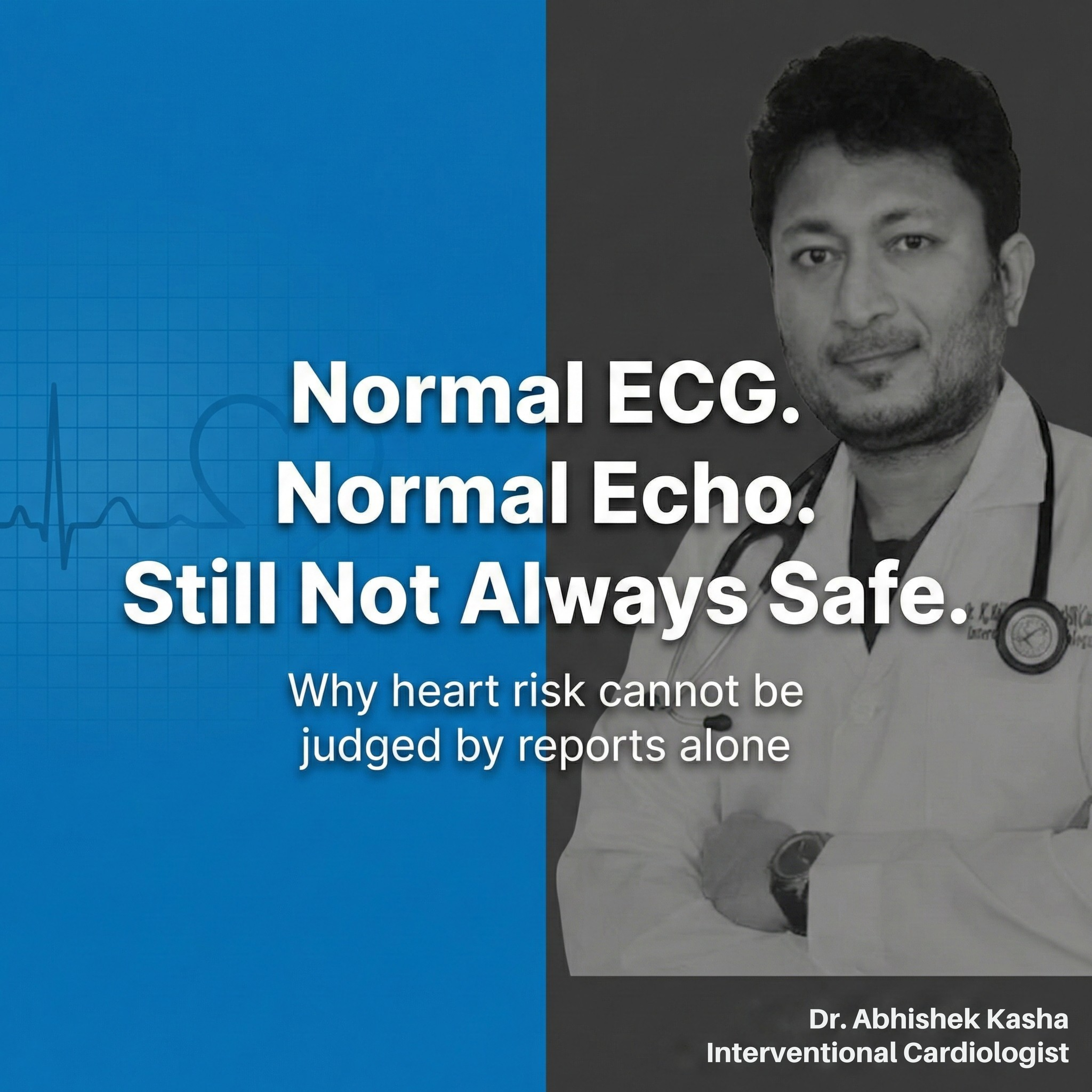
By Dr. Abhishek Kasha
Consultant Interventional Cardiologist
Many patients walk into my clinic holding their reports with visible relief.
“Doctor, my ECG is normal.”
“My echo report says everything is fine.”
They expect reassurance. Often, they expect closure.
While a normal ECG and echocardiogram are certainly good signs, they are not a final verdict on heart health. This is a difficult truth, but an important one.
A normal report does not always mean a normal heart.
Why This Matters Today More Than Ever
We are seeing an alarming rise in sudden cardiac events among people who appeared healthy just days earlier. Young professionals, diabetics with no prior symptoms, even doctors themselves. Many had recent reports that were labelled normal.
So how does this happen?
The answer lies in understanding what these tests can show and what they cannot.
What an ECG Really Tells Us
An ECG records the electrical activity of the heart at a single point in time. It is excellent at detecting rhythm disturbances, previous heart attacks, and major ongoing events.
But heart attacks are dynamic. In early stages, or in certain types such as NSTEMI, posterior wall infarction, or intermittent ischemia, the ECG can appear completely normal. Dangerous arrhythmias may also strike before any visible ECG abnormality develops.
In simple terms, a normal ECG today does not guarantee safety tomorrow.
What an Echocardiogram Shows and What It Misses
An echocardiogram is a powerful tool. It tells us about heart size, valve function, wall motion, and pumping strength. A normal ejection fraction often reassures patients.
However, an echo does not show the coronary arteries directly. It does not reveal plaque buildup, narrowing, or unstable lesions inside the vessels that supply blood to the heart.
A person can have a structurally normal heart and still be at high risk for a heart attack.
Heart Attacks Do Not Always Give Advance Notice
Most heart attacks do not occur because an artery was severely blocked for years. They happen when a plaque that was previously mild suddenly ruptures, triggering clot formation.
That rupture can occur without warning, without symptoms, and without prior abnormal tests.
This is why relying only on reports can be dangerous.
Sudden Cardiac Death Is Often Electrical
Many sudden cardiac deaths occur due to lethal arrhythmias. These are electrical failures, not structural ones.
In such cases, ECG changes and blood markers may appear only after the event, not before. This makes early recognition of symptoms and risk factors critical.
Risk Factors Accumulate Silently
Heart disease is rarely caused by one factor alone.
Diabetes, high blood pressure, smoking, obesity, abnormal cholesterol, chronic stress, poor sleep, sedentary lifestyle, and family history all add up over time. A single normal test cannot cancel years of accumulated risk.
This is especially true for people who say, “I feel fine” but live with multiple risk factors.
Symptoms Must Always Override Reports
This rule cannot be overstated.
Chest heaviness, breathlessness, cold sweats, jaw or arm pain, upper abdominal discomfort, unexplained fatigue, or sudden weakness should never be ignored because a test was normal.
This is particularly important in diabetics, elderly patients, and healthcare professionals, who often experience atypical symptoms and delay seeking help.
When symptoms speak, reports must listen.
One Test Is Never the Whole Story
Heart disease evolves over time. It reveals itself through patterns, not snapshots.
That is why serial ECGs, cardiac biomarkers such as troponin, repeated clinical evaluation, and structured risk assessment are essential in many cases.
Based on symptoms and risk, further evaluation such as stress testing, CT coronary angiography, or invasive angiography may be required. These decisions are guided by clinical judgment, not reassurance alone.
A Difficult Truth About Doctors
Doctors are often the worst patients.
Long hours, sleep deprivation, stress, denial, and the habit of postponing care take a heavy toll. Many tragic losses in the medical community could have been prevented by earlier attention to warning signs.
Stress and burnout are not harmless. They are cardiovascular risk factors.
Time Is Heart Muscle
Every minute matters in cardiology.
Early admission, observation, and repeat testing can make the difference between recovery and irreversible damage. Waiting at home with painkillers and denial has cost many lives.
The Message Every Patient Should Remember
A normal ECG or echo is reassuring.
It is valuable.
It is important.
But it is not a lifetime insurance policy.
Real heart care is guided by symptoms, risk factors, and timely action.
A normal report should never overrule an abnormal symptom.
Frequently Asked Questions
If my ECG and echo are normal, can I still have heart disease?
Yes. These tests may not detect early coronary artery disease, unstable plaques, or electrical instability.
Does a normal ejection fraction mean my heart is safe?
A normal ejection fraction means pumping function is good, but it does not rule out blocked arteries or future heart attacks.
Can heart attacks occur without ECG changes?
Yes. Many heart attacks, especially NSTEMI or early events, may have a normal ECG initially.
When should I seek emergency care despite normal reports?
Any chest discomfort, breathlessness, sweating, jaw or arm pain, unexplained fatigue, or sudden weakness should prompt immediate evaluation.
Are diabetics at higher risk even with normal tests?
Yes. Diabetics often have silent ischemia and atypical symptoms. Normal tests do not eliminate risk.
How often should ECG or echo be repeated?
There is no fixed rule. Testing depends on symptoms, risk factors, and clinical judgment.
Do stress and lack of sleep really affect the heart?
Absolutely. Chronic stress and sleep deprivation significantly increase cardiovascular risk.
Is one normal test enough to rule out future problems?
No. Heart disease is dynamic. Risk assessment is ongoing, not one time.