Breaking Calcium in the Heart Arteries – Advanced Angioplasty
First-of-its-kind in Rayalaseema at ASTER Narayanadri, Tirupati
Performed by: Dr. Abhishek Kasha, Interventional Cardiologist
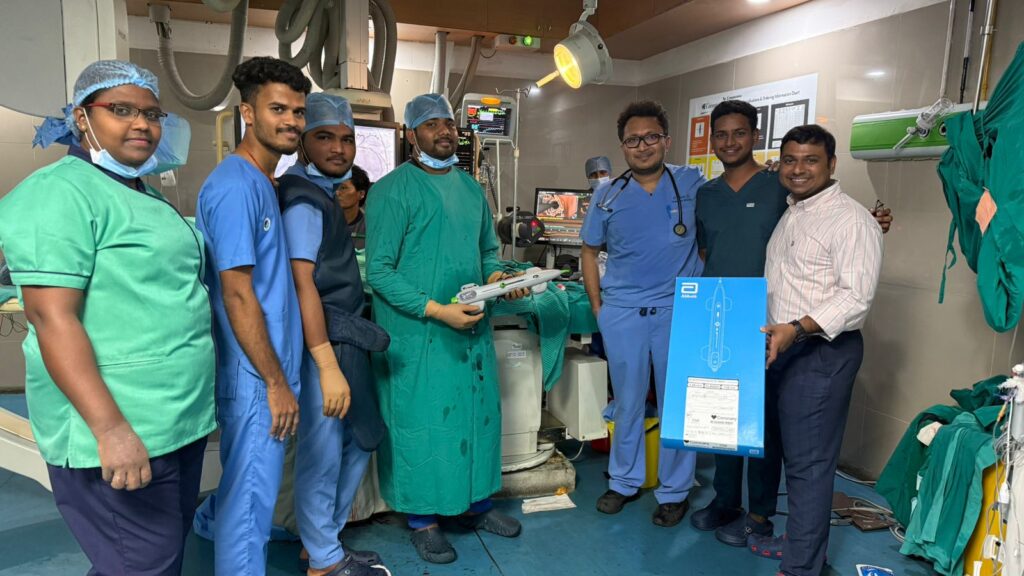
The Challenge: When Arteries Turn to Stone
For elderly and diabetic patients, calcium in the heart arteries is one of the toughest enemies. In this case, the challenge was extreme:
- The patient’s main artery had deep, nodular, and circumferential (360°) calcium.
- The vessel was so rigid, it was like trying to inflate a balloon inside stone.
- Standard balloons simply failed. Stents could not expand.
- Without proper treatment, this would mean high chances of re-narrowing, clotting, and even heart attack recurrence.
This wasn’t a routine angioplasty. This was a battle against rock-hard calcium inside the most vital artery of the heart.
Seeing Beyond the Angiogram: Why Imaging & Physiology Mattered
A simple angiogram wasn’t enough here. What looked like a blockage on X-ray might not always be causing trouble — and sometimes what looks mild can be lethal.
That’s where modern tools stepped in:
- Physiology (FFR/RFR): Confirmed that other arteries (LCX, RCA) were not restricting blood flow. That meant no unnecessary stents.
- OCT (Optical Coherence Tomography): Like switching on a high-definition camera inside the artery. It revealed:
- 360° calcium rings
- Sharp calcium nodules
- A dangerously narrow lumen — just 1.6 mm² wide (healthy is usually 6–7 mm² or more).
Armed with this crystal-clear insight, the team planned a strategy tailored to the patient — choosing the right devices, balloon types, and stent sizes with absolute precision.
The Game-Changer: Orbital Atherectomy
When balloons can’t break calcium, doctors need stronger tools.
Enter Orbital Atherectomy — a diamond-crowned device that literally sands calcium from inside the artery.
- It spins and orbits, grinding away the hardest calcium without blocking blood flow.
- Done in careful runs, with pauses, to keep the patient safe.
- Requires top expertise — in the wrong hands, it can cause vessel injury.
In Dr. Kasha’s hands, the atherectomy transformed a rock-hard artery into a vessel that was finally ready to accept stents.

The PCI & The Victory
Once the calcium was cracked, the rest of the procedure became smooth:
- Drug-Eluting Stents (DES): Placed in the LAD, the main artery.
- High-pressure balloons: Ensured perfect expansion.
- OCT re-check:
- Stents were fully expanded and snugly fitted
- Minimum stent area improved to 8 mm²
- No damage, no clot, no compromise to side branches
- Final Angiogram: TIMI 3 flow — meaning blood flow was restored to normal, the best possible result.
It wasn’t just an angioplasty. It was precision engineering inside the human heart.
Why This Case is a Landmark
This was more than just a successful procedure — it was a medical milestone for Rayalaseema and Andhra Pradesh.
✅ First time combining in one case:
- Imaging (OCT)
- Physiology (FFR/RFR)
- Orbital Atherectomy
- Precision PCI
✅ Outcomes ensured:
- Correct decisions, avoiding unnecessary stents
- Optimal stent expansion, even in stone-like arteries
- Long-term durability and safety for the patient
For the people of Tirupati and Rayalaseema, this sets a new benchmark in cardiac care — advanced techniques available locally, without needing to travel to metro cities.
Key Takeaways
- Not every blockage needs a stent → physiology prevents over-treatment.
- Calcium is the silent killer in Indian hearts → without proper modification, angioplasty often fails.
- Imaging is the guide, not the luxury → it ensures accuracy, safety, and long-term success.
- Skill matters most → advanced tools like orbital atherectomy demand experienced hands.
About Dr. Abhishek Kasha
Dr. Abhishek Kasha is a leading Interventional Cardiologist with expertise in complex angioplasties, advanced imaging-guided interventions, and cutting-edge techniques like atherectomy, physiology-guided PCI, and high-risk coronary procedures.
With a passion for precision and patient-first care, Doctor has helped bring advanced heart treatments to the people of Rayalaseema, ensuring patients don’t need to travel far for world-class cardiology care.
Consulting Location
📍 ASTER Narayanadri Hospital
Tirupati, Andhra Pradesh
FAQs
1. What is calcium in the heart arteries?
Calcium in arteries is different from bone calcium. Over years, cholesterol and plaque harden, turning into calcium deposits that make arteries stiff like stone.
2. Why is calcium dangerous during angioplasty?
If the artery is too hard, balloons and stents cannot expand. This leads to poor results, re-blockages, and higher risk of complications.
3. What is Orbital Atherectomy?
It’s an advanced device with a diamond-coated crown that sands down calcium from inside arteries, allowing balloons and stents to work effectively.
4. Is atherectomy safe?
Yes, in expert hands. It requires high operator skill, but when done properly, it makes angioplasty safer and longer-lasting in complex cases.
5. Do all blockages need stents?
No. Using physiology (FFR/RFR), doctors can check whether a blockage is truly restricting blood flow. If it isn’t, unnecessary stents can be avoided.
6. How does imaging help?
Imaging (like OCT) works like a high-definition scan inside arteries, helping doctors measure calcium, size stents accurately, and avoid mistakes.