When someone is told they may need a heart procedure, two words often come up very quickly: angioplasty and stent. Many people think they mean the same thing. Others assume one is better than the other. In reality, they are closely connected — but they are not the same.
The simplest way to understand it is this:
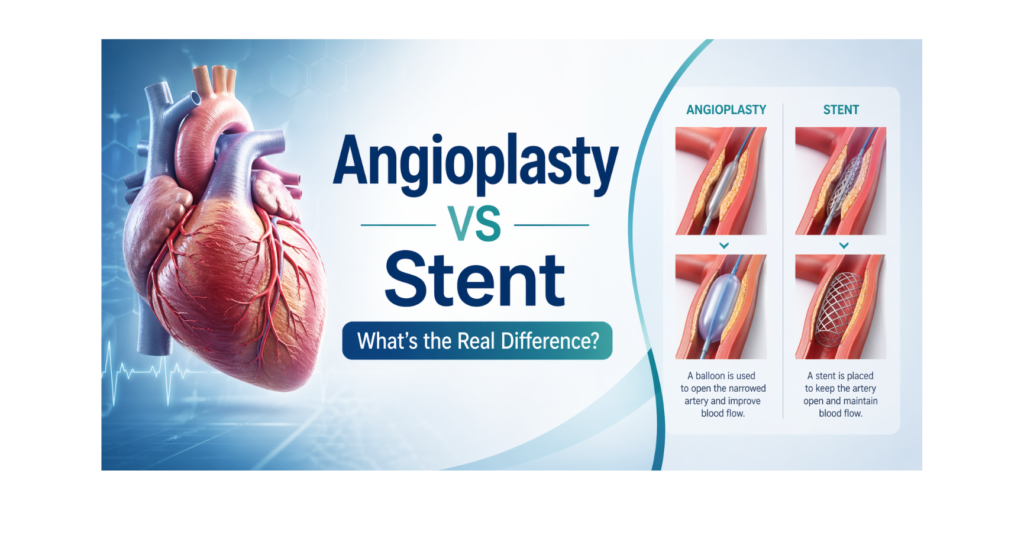
Angioplasty is the procedure used to open a blocked or narrowed artery. A stent is a small tube-like device that may be placed inside the artery during that procedure to help keep it open.
That is the most important difference.
Understanding this can make it much easier for patients and families to follow what the doctor is recommending, why it is being done, and what to expect afterward.
Why this confusion happens so often
In heart treatment, angioplasty and stent placement are commonly performed together. Because they happen in the same setting, people often use the words interchangeably.
For example, one person may say, “I had a stent.” Another may say, “I had angioplasty.” In many cases, both statements refer to the same hospital visit. But medically, they describe two different parts of treatment.
This distinction matters because not every angioplasty is exactly the same, and not every blocked artery is managed in an identical way.
What is angioplasty?
Angioplasty is a minimally invasive procedure used to improve blood flow in an artery that has become narrow or blocked, usually because of fatty deposits called plaque.
In heart patients, this is usually done when the coronary arteries — the blood vessels that supply the heart muscle — have become narrowed. When blood flow is reduced, a person may develop chest pain, shortness of breath, fatigue on exertion, or even a heart attack.
During angioplasty, a doctor inserts a thin tube called a catheter into a blood vessel, often through the wrist or groin, and carefully guides it to the blocked artery. A very small balloon at the tip is then inflated at the site of the narrowing. This pushes the plaque against the artery wall and creates more space for blood to flow.
So, angioplasty is essentially the act of opening the artery.
What is a stent?
A stent is a small mesh tube that can be placed inside the artery after it has been opened with angioplasty.
Its purpose is to support the artery from inside and help prevent it from becoming narrow again too quickly. Once placed, the stent remains in the artery permanently.
You can think of it as a tiny scaffold. After the balloon opens the narrowed area, the stent helps hold that passage open so blood can continue moving more freely.
In many modern heart procedures, doctors use drug-eluting stents, which slowly release medication to reduce the chance of the artery narrowing again. These are commonly used because they improve long-term results in many patients.
The easiest way to remember the difference
A simple comparison makes this clear:
Imagine a road that has become too narrow because debris has built up.
- Angioplasty is the process of clearing and widening the road.
- A stent is the support structure placed there to help keep the road open.
So when a doctor says a patient needs angioplasty, that refers to the procedure. If the doctor says a stent will be placed, that refers to a device used during or after that procedure.
Are angioplasty and stent always done together?
Not always, but very often.
In many cases, once the artery is opened with a balloon, the doctor places a stent to improve the result and reduce the risk of the artery narrowing again. However, the exact treatment depends on many factors, including:
- the location of the blockage
- the size of the artery
- the nature of the plaque
- whether the patient is having a heart attack
- the patient’s bleeding risk
- the overall condition of the heart
- whether the blockage is simple or complex
So while stents are very common, the treatment plan is always individualized.
Why angioplasty alone may not always be enough
When the balloon is inflated during angioplasty, it opens the artery by compressing the blockage and stretching the vessel. But once the balloon is removed, the artery may not always stay open in the best possible way on its own.
There may be a chance of:
- the artery recoiling
- the vessel wall becoming unstable
- the narrowed area returning over time
A stent helps address these concerns by giving structural support to the artery after it has been opened.
That is why, in many cases, stent placement becomes an important part of the overall treatment.
When is angioplasty with stent recommended?
This treatment is often considered when a patient has significant blockage in one or more coronary arteries and symptoms or risk that justify opening the vessel.
A cardiologist may recommend it in situations such as:
- chest pain caused by reduced blood flow to the heart
- worsening angina despite medicines
- reduced blood supply seen on testing
- a heart attack caused by sudden artery blockage
- critical narrowing in an important coronary artery
In emergency situations, such as a heart attack, angioplasty with stent placement can be lifesaving because it restores blood flow quickly.
Does a stent cure heart disease?
This is one of the most important things patients should understand: a stent treats a blockage, but it does not cure the underlying disease process.
Coronary artery disease develops over time because of plaque buildup in the arteries. A stent can open one dangerous or symptom-causing narrowing, but it does not remove the tendency of the body to form plaque elsewhere.
That is why treatment does not end after the procedure.
Patients still need long-term care, which may include:
- blood-thinning medicines
- cholesterol-lowering treatment
- blood pressure control
- diabetes management
- smoking cessation
- regular exercise
- heart-healthy eating
- follow-up with a cardiologist
In simple words, the procedure fixes an immediate problem, but lifestyle and medical treatment are what help protect the future.
Which is more important: angioplasty or the stent?
This is not really an either-or question, because they play different roles.
Angioplasty is important because it opens the narrowed artery. The stent is important because it helps maintain that opening.
One is the treatment step. The other is the support device.
So instead of asking which one is better, it is more accurate to understand how they work together in many patients.
What happens after a stent is placed?
After a stent is inserted, recovery is usually quicker than with open-heart surgery, though it still requires careful follow-up.
Patients are often advised to:
- take medicines exactly as prescribed
- avoid stopping blood thinners without medical advice
- monitor for chest discomfort or unusual symptoms
- attend follow-up appointments
- make long-term lifestyle changes
This is especially important because the success of the procedure depends not only on what happens in the cath lab, but also on what happens after discharge.
Can someone need angioplasty without surgery?
Yes. Angioplasty is not open-heart surgery. It is a catheter-based procedure, which means it is done through blood vessels using specialized tubes and instruments.
This is one reason why it is considered less invasive than bypass surgery. However, that does not mean it is minor or casual. It is still a significant cardiac procedure and should be performed only after proper evaluation.
In some patients, angioplasty with stenting is the best option. In others, medicines may be enough. In some complex cases, bypass surgery may be more suitable. The right treatment depends on the patient’s anatomy, symptoms, risk factors, and overall heart condition.
Why doctors sometimes say “PCI” instead
You may also hear the term PCI, which stands for Percutaneous Coronary Intervention.
This is the broader medical term often used for procedures that include angioplasty and, when needed, stent placement. So if a doctor says a patient underwent PCI, that may include balloon angioplasty, stenting, or both.
Final takeaway
If you remember only one thing, remember this:
Angioplasty is the procedure used to open a blocked artery. A stent is the small mesh tube that may be placed during that procedure to help keep the artery open.
They are related, but they are not the same.
Understanding this difference helps patients ask better questions, follow their treatment plan more confidently, and feel less overwhelmed when discussing heart procedures with their doctor.
When used in the right patient, at the right time, angioplasty and stent placement can significantly improve blood flow, relieve symptoms, and in emergency cases, even save life. But they work best when combined with long-term heart care, proper medication, and healthy lifestyle changes.
FAQs
1. Is angioplasty the same as a stent?
No. Angioplasty is the procedure used to open the artery. A stent is the device that may be placed inside the artery during that procedure.
2. Do all angioplasty procedures need a stent?
Not always. Many do, but the decision depends on the type of blockage, the artery involved, and the patient’s overall condition.
3. Is a stent permanent?
Yes, in most cases the stent stays inside the artery permanently.
4. Does having a stent mean heart disease is cured?
No. A stent treats a specific blockage, but the underlying disease still needs long-term control with medicines and lifestyle changes.
5. Is angioplasty a surgery?
It is a minimally invasive catheter-based procedure, not open-heart surgery.
6. Can a person live normally after angioplasty and stent placement?
Many people return to normal activities after recovery, but they must follow medical advice, take prescribed medicines, and maintain heart-healthy habits.
7. What is the main purpose of a stent?
The main purpose is to help keep the artery open after angioplasty and reduce the chance of it narrowing again.
8. Is angioplasty done only during a heart attack?
No. It can be done in an emergency heart attack situation, but it can also be done as a planned treatment for significant artery narrowing causing symptoms.
Dr. Abhishek Kasha
Consultant Interventional Cardiologist & Heart Failure Specialist
Aster Narayanadri Hospital
Dr. Abhishek Kasha is a highly trained and experienced Interventional Cardiologist and Structural Heart Specialist, known for bringing advanced, metro-level cardiac care to Tirupati and nearby regions. His clinical focus includes complex coronary interventions, structural heart procedures such as TAVI/TAVR, and comprehensive heart failure management.