Healthcare is rapidly evolving, and advanced treatments are no longer limited to big metro cities alone. A proud and historic milestone was recently achieved at Aster Narayanadri Hospital, Tirupati, where a first-of-its-kind complex bilateral aorto-iliac angioplasty with kissing stents was successfully performed in a Tier-2 city.
This highly complex and technically demanding procedure was led by Dr. Abhishek Kasha (Dr. AK) and his expert team, offering new hope to patients suffering from severe Peripheral Arterial Disease (PAD)—without the need for open surgery.
Patient & Clinical Background
The patient was a 58-year-old male who came to the hospital with severe symptoms of Peripheral Arterial Disease (PAD) affecting both lower limbs.
His main complaints included:
- Severe rest pain in the legs
- Difficulty walking even short distances
- Complete absence of pulse in the left leg, from the groin (femoral artery) to the foot (dorsalis pedis)
- Very weak pulse in the right leg
These symptoms indicated critical reduction of blood flow to the legs, a condition that can progress to non-healing ulcers, gangrene, or even limb loss if not treated on time.
Angiography Findings: The Real Challenge
Detailed angiography revealed a very high-risk vascular anatomy:
- Left Common Iliac Artery – Chronic Total Occlusion (CTO) (completely blocked)
- Right Common Iliac Artery – Critical narrowing at the origin (ostial stenosis)
This type of bilateral aorto-iliac disease is among the most challenging forms of PAD and is traditionally managed with open abdominal or iliac bypass surgery, which carries higher risks, longer recovery, and more complications—especially in elderly or high-risk patients.
Why This Case Was Extremely Complex
This was not a routine angioplasty. The complexity came from multiple factors:
- Blockage on both sides of the aorto-iliac junction
- Complete blockage on the left side, with no femoral pulse to access
- Critical narrowing on the right side
- Disease located at the aorto-iliac bifurcation, a technically sensitive area
- Traditionally managed by open surgery, not catheter-based treatment
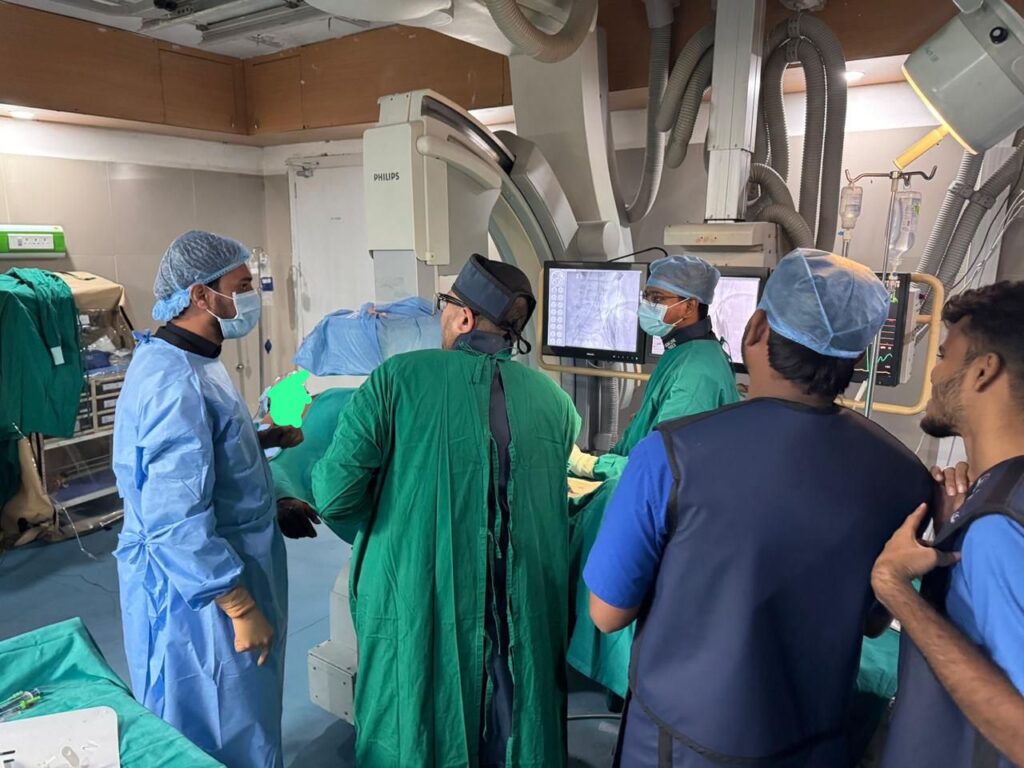
Performing a minimally invasive solution in such anatomy requires high expertise, advanced planning, and excellent cath lab support.
The Advanced Endovascular Solution (13/12/2025)
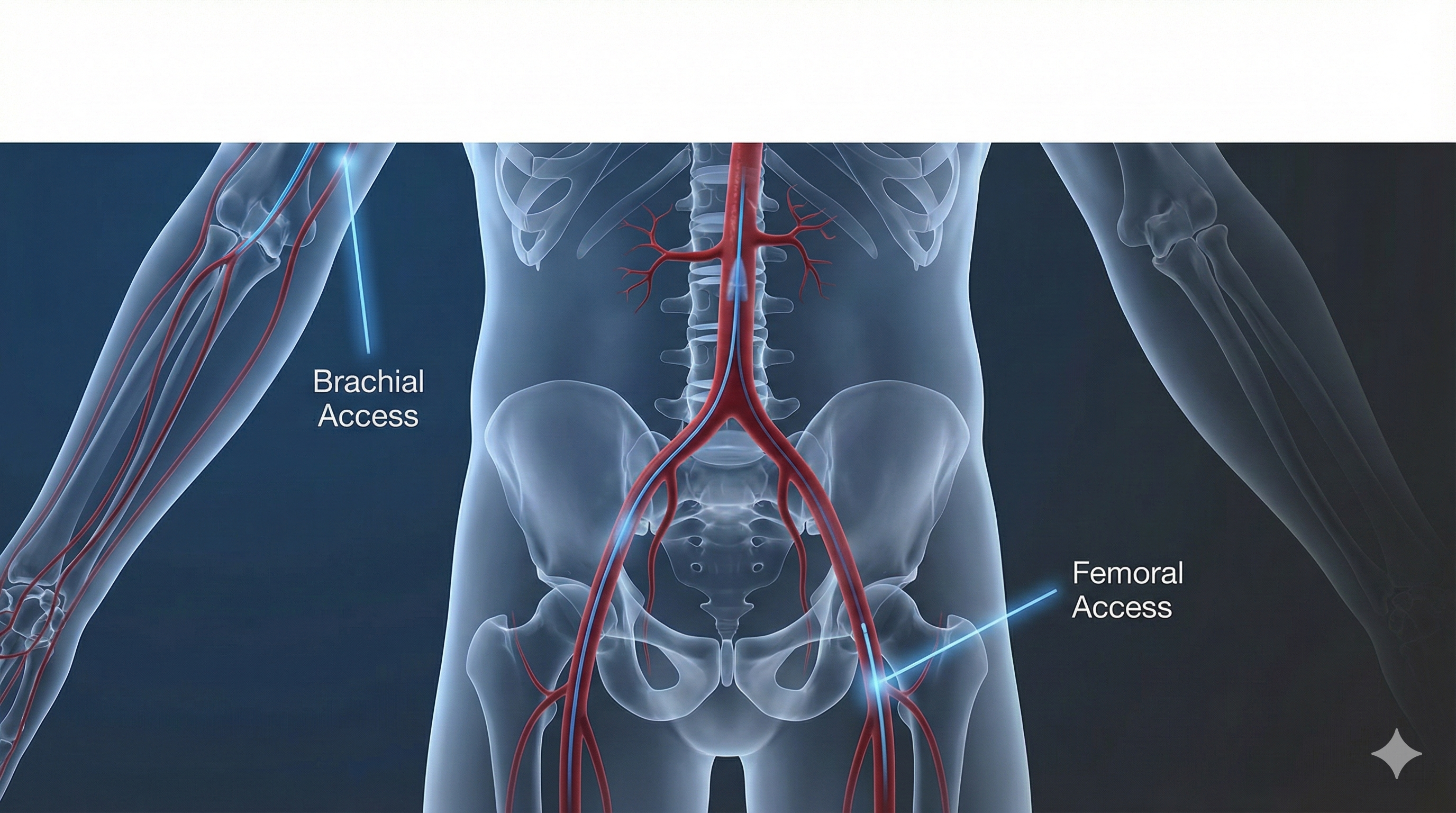
Instead of opting for high-risk open surgery, Dr. Abhishek Kasha and team chose an innovative dual-access endovascular strategy, combining skill, technology, and precision.
Dual Access Approach:
- Left Brachial Artery (arm access)
→ Used to cross the left iliac chronic total occlusion - Right Femoral Artery (groin access)
→ Used for precise stent positioning and deployment
This dual access allowed safe navigation across complex blockages that would otherwise be extremely difficult.
Kissing Aorto-Iliac Stenting Technique
Once access was secured, the team performed a kissing stent technique to reconstruct the aorto-iliac bifurcation.
Stents Used:
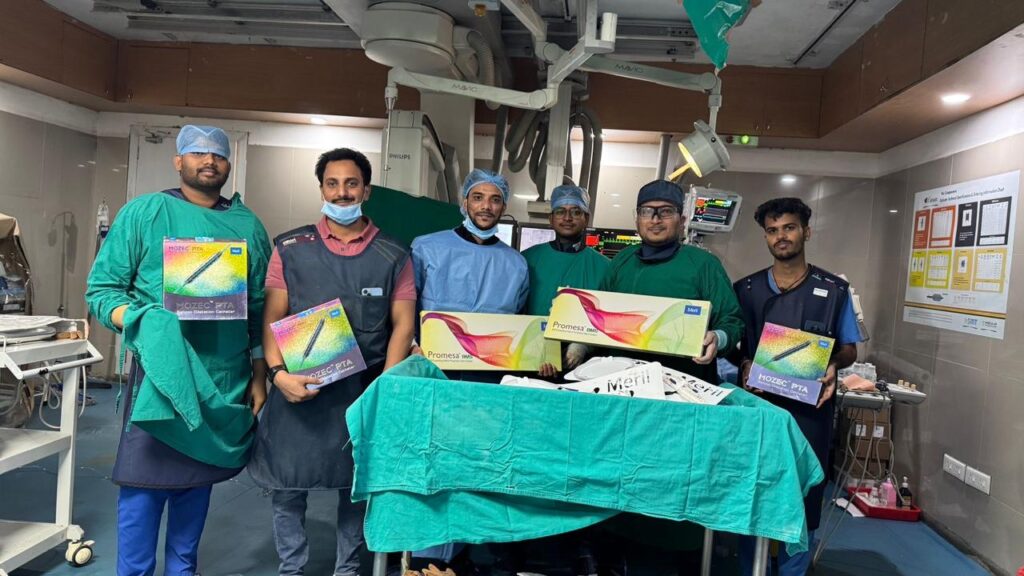
- PROMESA Self-Expanding Stents
- 9.0 × 80 mm – Aorta to Right Common Iliac
- 8.0 × 80 mm – Aorta to Left Common Iliac
Key Step:
- Simultaneous kissing balloon dilatation
- This ensures equal expansion on both sides
- Restores normal blood flow at the bifurcation
- Prevents future narrowing at the junction
This advanced endovascular method completely avoided open surgery.
Outstanding Clinical Outcome
The results were immediate and remarkable:
✔ Excellent angiographic result
✔ Strong, brisk blood flow restored to both legs
✔ All peripheral pulses palpable after the procedure
✔ Complete relief from rest pain
✔ Patient now walks comfortably without claudication
From absent pulses and severe pain to strong pulses in both legs, the transformation was dramatic and life-changing.
Why This Achievement Matters
This case is not just about one patient—it represents a major leap in healthcare delivery.
Key Significance:
- Brings metro-level vascular care to a Tier-2 city
- Reduces the need for patients to travel long distances
- Avoids high-risk open surgeries
- Establishes Aster Narayanadri Hospital as a center for complex PAD and aorto-iliac interventions
- Highlights the growing role of advanced endovascular therapy in limb salvage
Understanding Peripheral Arterial Disease (PAD)
PAD is a condition where arteries supplying blood to the legs become narrowed or blocked due to plaque buildup.
Common risk factors:
- Diabetes
- Smoking
- High blood pressure
- High cholesterol
- Age above 50
Warning signs:
- Leg pain while walking
- Rest pain in legs or feet
- Cold feet or color changes
- Non-healing wounds
Early diagnosis and timely treatment can save limbs and lives.
Acknowledgements
This successful intervention reflects the teamwork and dedication of:
- Cath lab staff
- Nursing team
- Anesthesia support
- Hospital management
Their combined effort made this advanced procedure possible in a Tier-2 city setting.
Lead Operator
Dr. Abhishek Kasha (Dr. AK)
Lead Consultant Interventional Cardiologist
Heart Failure Specialist
Aster Narayanadri Hospital, Tirupati, Andhra Pradesh
Frequently Asked Questions (FAQs)
1. What is aorto-iliac angioplasty?
It is a minimally invasive procedure to open blocked arteries at the junction of the aorta and iliac arteries using balloons and stents.
2. What does “kissing stents” mean?
Two stents are placed simultaneously into both iliac arteries from the aorta to treat blockages on both sides evenly.
3. Is this procedure safer than open surgery?
Yes. In suitable patients, endovascular treatment has less pain, lower risk, shorter hospital stay, and faster recovery.
4. Why was dual access needed?
Because one artery was completely blocked, accessing it from the arm (brachial) helped safely cross the blockage.
5. How long is recovery after angioplasty?
Most patients can walk within a day and return to normal activities much faster than after open surgery.
6. Can PAD come back after treatment?
With proper medication, lifestyle changes, and follow-up, long-term results are excellent.
7. Who should get checked for PAD?
People with diabetes, smokers, or those with leg pain while walking should seek early evaluation.